
Record the baseline.
The PM confirms the links from source excerpt to assumption, acceptance criterion, and task. The agreed scope is saved as a baseline version.
APPROVED SCOPE / SOURCE LINKFor 1–5-person B2B SaaS product teams using Linear or Jira. Review new customer evidence against agreed acceptance criteria and work already in progress.
Linear or Jira
Customer support + recorded calls
NOVI EDGE FZCO
STARTUP PROGRAMME MEMBERSHIPS
A feature is already in development when another customer call challenges the assumption behind it. The PM has to find the agreed requirement, locate the affected work, and decide whether to reopen the scope.
We’re building Threadline around that review. Each approved requirement would keep a link to its evidence and delivery tasks, so a proposed change can be checked against the original decision.
Four concept screens with sample data
explore how evidence could stay linked to scope.
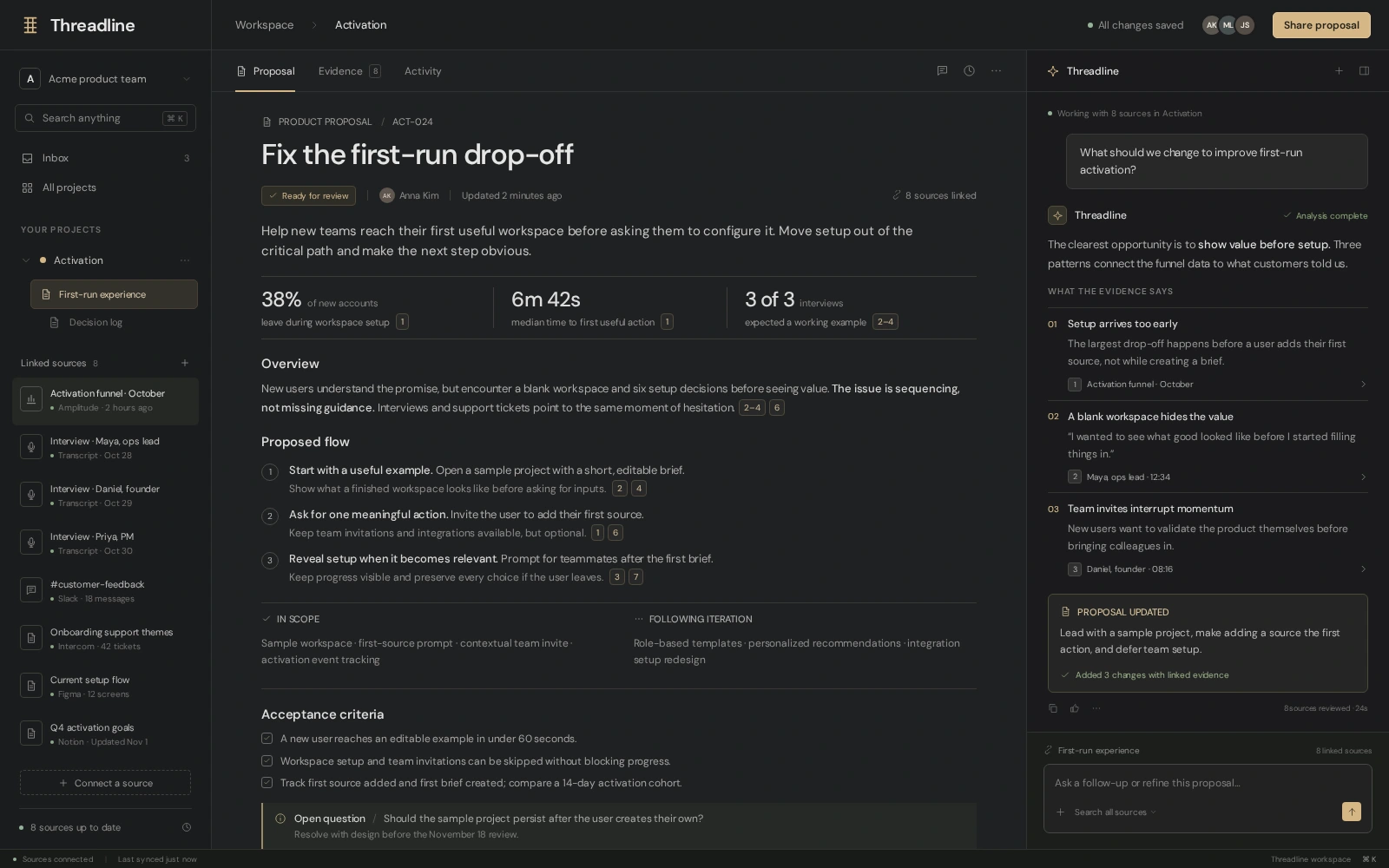
Store the original excerpt, its date, and the customer context beside the assumption it supports.
Confirm which acceptance criteria depend on that assumption and which tasks implement them.
Compare new evidence with the agreed baseline. Approve a change brief before revising the handoff.
For the first pilot, we plan to focus on B2B SaaS onboarding. Suppose the team agreed to require a teammate invitation before the first brief. A later interview reveals that the user must show value internally before inviting colleagues.
Threadline would flag the assumption about when to invite teammates, the blocking acceptance criterion, and the linked task. The PM would see both excerpts and proposed edits, then decide whether the evidence applies to this customer segment.
Illustrative scenario. The workflow is in development and has not been validated with customer teams.
See the proposed review flow
Planned for evidence that arrives
while a feature is already in development.
The PM confirms the links from source excerpt to assumption, acceptance criterion, and task. The agreed scope is saved as a baseline version.
APPROVED SCOPE / SOURCE LINKCompare a new excerpt with the baseline. Check the persona, customer segment, and situation before proposing a conflict.
NEW SOURCE / POSSIBLE CONFLICTShow linked criteria and tasks that may need review, with the original evidence and proposed edits. Flag missing links for the PM to check.
CRITERIA / TASKS / PROPOSED DIFFThe PM accepts, rejects, or requests more evidence. An approved change becomes a new baseline and a copyable brief; external tasks stay unchanged.
HUMAN REVIEW / VERSIONED HANDOFF
Threadline is developed by Novi Edge FZCO. The initial product concept focuses on reviewing new customer evidence against requirements already in development.
contact@threadline.comWhere the product stands,
and what to expect.
Our initial customer focus is product teams of 1–5 at B2B SaaS companies with 20–200 employees, where customer evidence is spread across support conversations, call recordings, and delivery tools.
A workspace for reviewing new customer evidence against requirements already agreed with engineering. The proposed review connects a source excerpt to an approved assumption, its acceptance criteria, and the linked tasks in progress.
The focus is a decision after handoff: does a new interview or support conversation challenge a requirement already in the sprint? We plan to compare it with a versioned, PM-approved baseline and prepare a change brief for specific linked criteria and tasks. This is a product hypothesis to test with teams, not a claim that competing tools cannot do it.
The PM first confirms the links between evidence, assumptions, criteria, and tasks. When new evidence arrives, Threadline would propose possible conflicts and check the customer persona and context. The PM could approve a change, reject it, or ask for more evidence. Unlinked work would remain outside the review; no task would change automatically.
No production integrations are available yet. The first pilot is planned around uploaded interview transcripts and read-only Linear access, with a change brief the PM can copy. Jira, Intercom, Zendesk, and Gong are candidates for later validation.
Threadline is in development. The four product screens illustrate the proposed workspace using sample data; they are not evidence of a deployed product or live customer results.
We save your email and a record of your request, so we can contact you about early access. The privacy notice explains the operator, purpose, retention criteria, and how to withdraw. Signing up does not connect any of your tools.
We’re developing evidence review for small B2B SaaS product teams, starting with onboarding decisions already in delivery.